Freddy Ogando
Quantitative Research | Development | Macro-Financial Risk
Quantitative research and computational tool development for data-driven decision-making
At the intersection of economic reasoning, applied mathematics and computer science.
The central purpose of this space is simple: to share applied knowledge and contribute to a more rigorous understanding of macroeconomics, financial systems, and evolving risk. It is guided by the view that research and models should not only describe empirical patterns, but also explain underlying mechanisms, support decision-making, and contribute to the development of intelligent systems.
Quantitative Development
R, C++, SQL, Python, and MatLab.
The objective is to support the development of research-grade, production-oriented pipelines for data processing, signal construction, model estimation, and high-performance implementation.
Reproducible Research Infrastructure
Quarto, Git/GitHub, LaTeX, research standards, and automated reporting.
Promote transparent, version-controlled workflows, rigorous empirical validation, and repeatable macro-financial research through modern tools and reproducible practices.
Macro Data and Signal Modeling
Time-series, high-frequency indicators, feature engineering, backtesting, and diagnostics.
Focus on transforming macro-financial information into structured indicators, predictive signals, and empirically testable insights.
Applied Macro-Financial Risk Research
Selected technical research that I have authored or co-authored, focused on financial stability, deposit dynamics, credit conditions and macro-financial linkages.
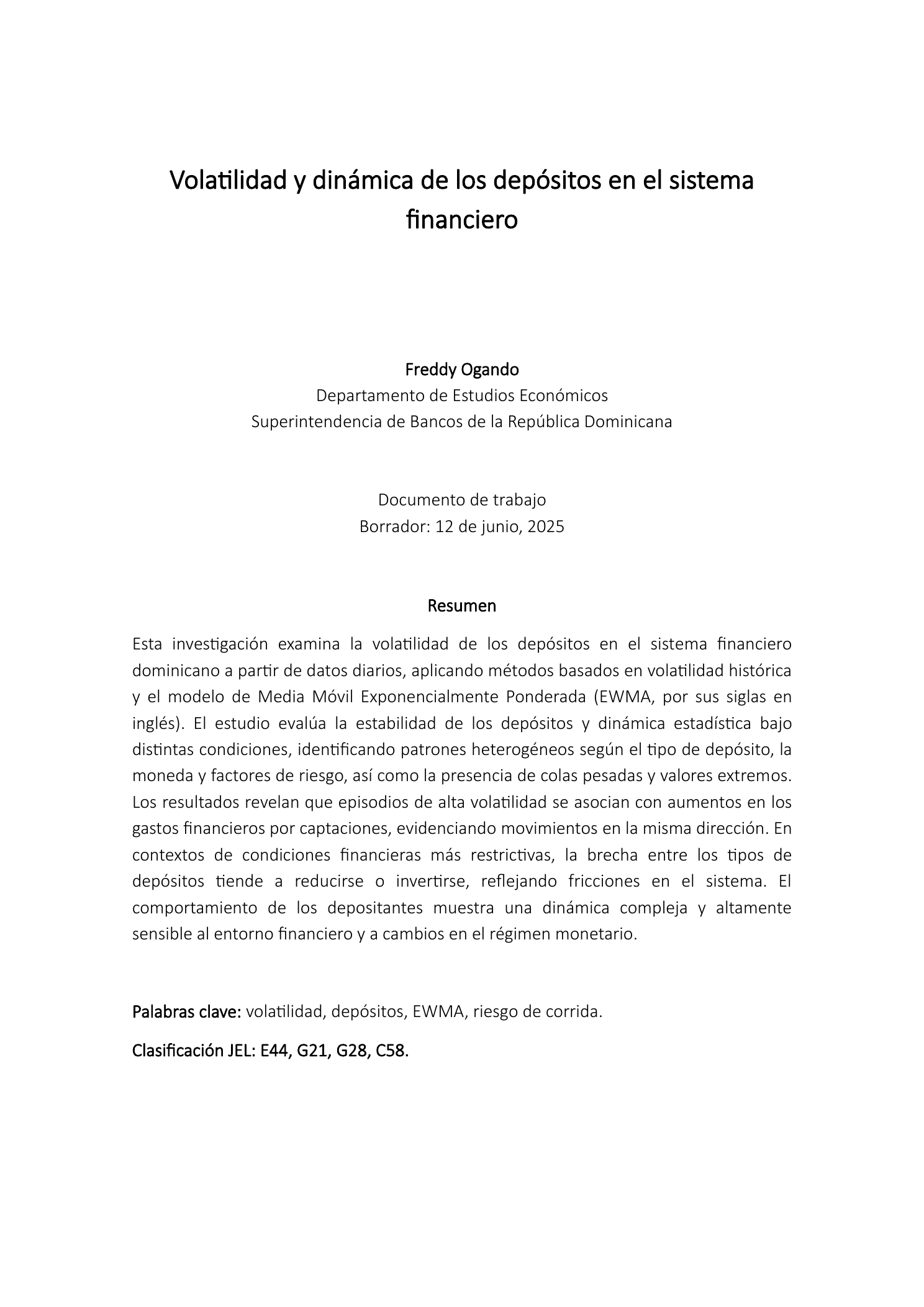
2025 — Volatility and Dynamics of Deposits in the Financial System
Institution: Superintendencia de Bancos de la República Dominicana
Author: Freddy Ogando
Type: Technical publication
This study analyzes deposit volatility in the financial system using daily data and volatility measures such as historical volatility and the EWMA model. The results show that deposit dynamics are sensitive to financial conditions, with episodes of higher volatility associated with increases in funding costs and signs of friction during restrictive financial environments.
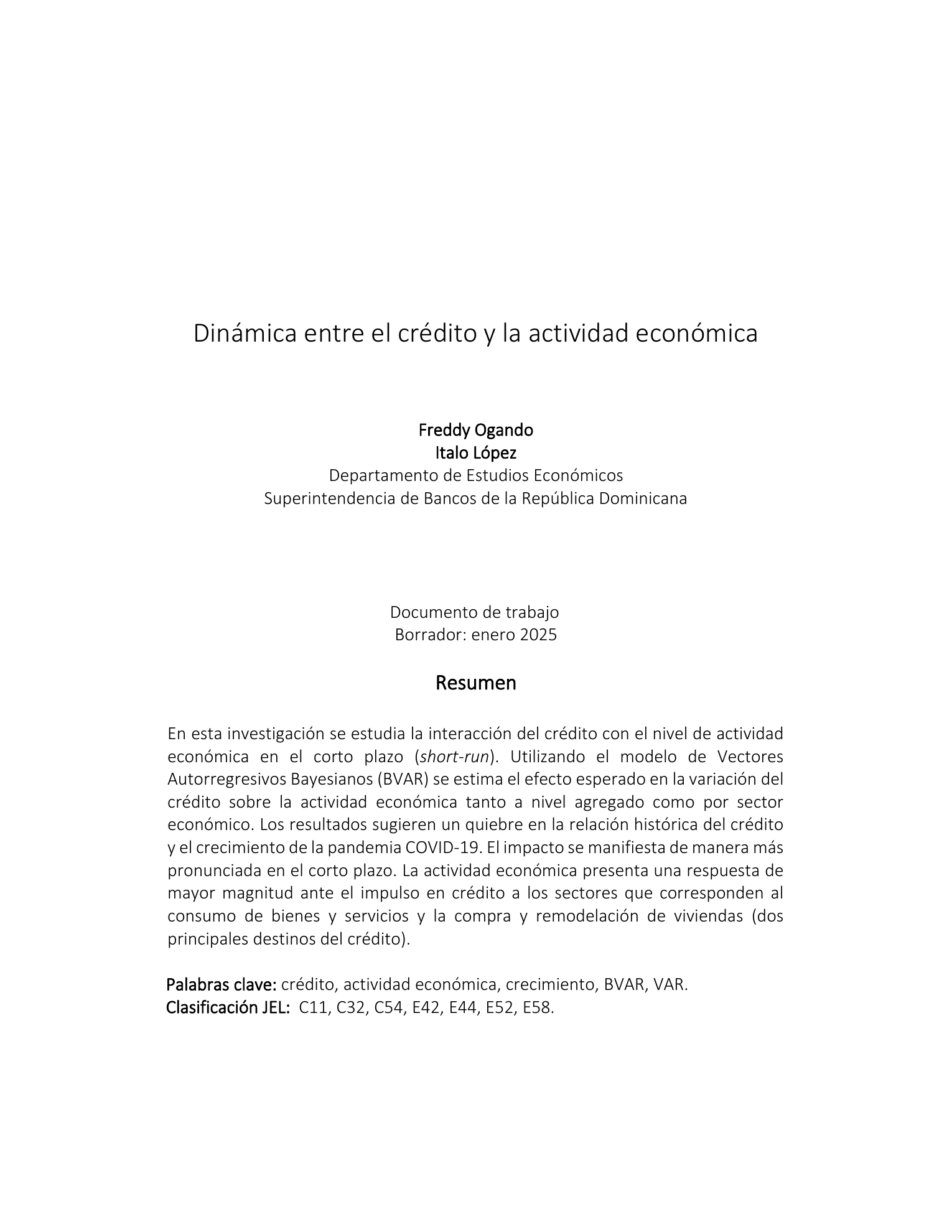
2025 — Dynamics Between Credit and Economic Activity
Institution: Superintendencia de Bancos de la República Dominicana
Authors: Freddy Ogando and Ítalo López
Type: Technical publication
This research studies the short-run interaction between credit and economic activity. A Bayesian Vector Autoregression model is used to estimate expected effects at both the aggregate level and across economic sectors, providing evidence on how credit conditions and real activity interact over time.
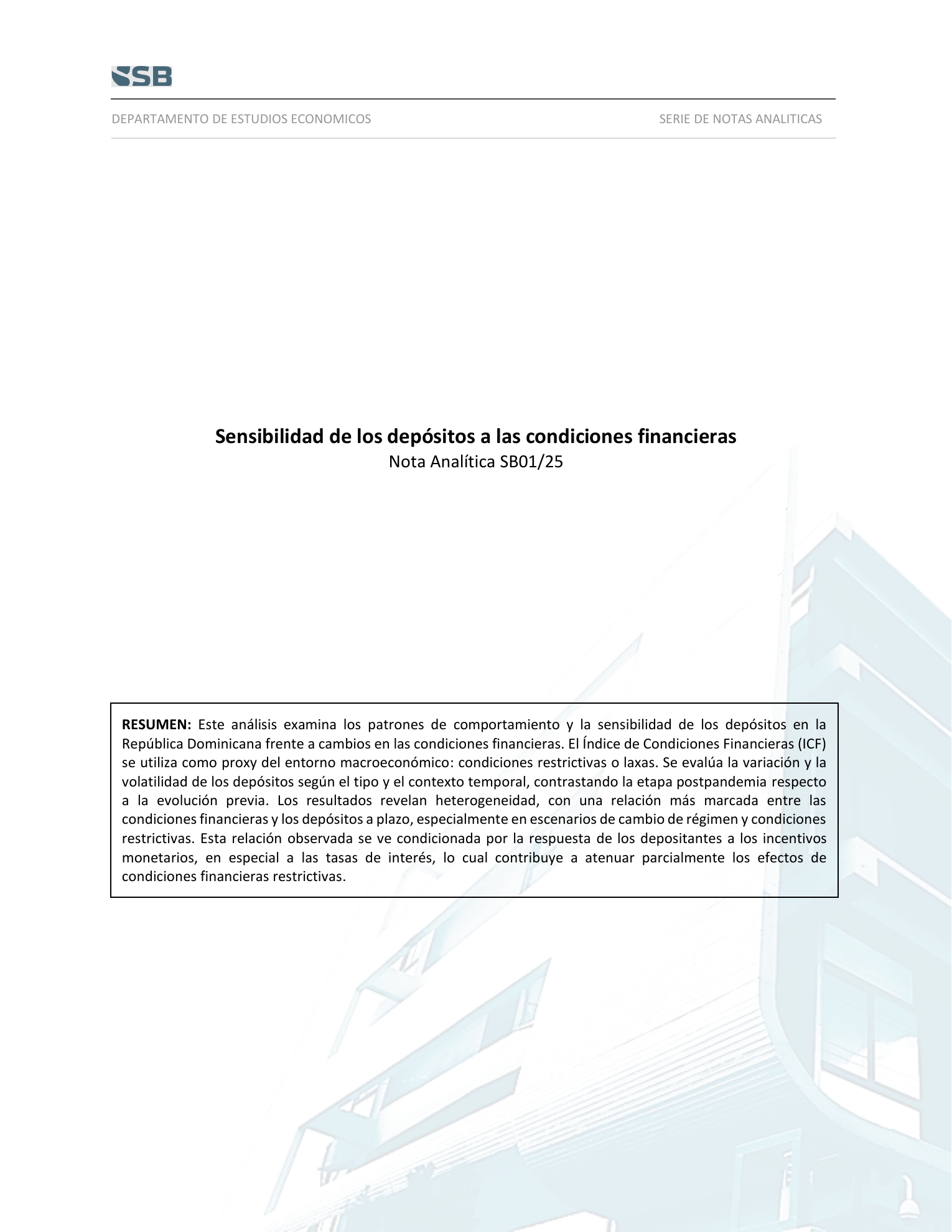
2025 — Sensitivity of Deposits to Financial Conditions
Institution: Superintendencia de Bancos de la República Dominicana
Author: Freddy Ogando
Type: Analytical note
This analytical note examines behavioral patterns and the sensitivity of deposits to changes in financial conditions in the Dominican Republic. The analysis contributes to understanding how depositors respond to shifts in interest rates, liquidity conditions, and broader macro-financial pressures.